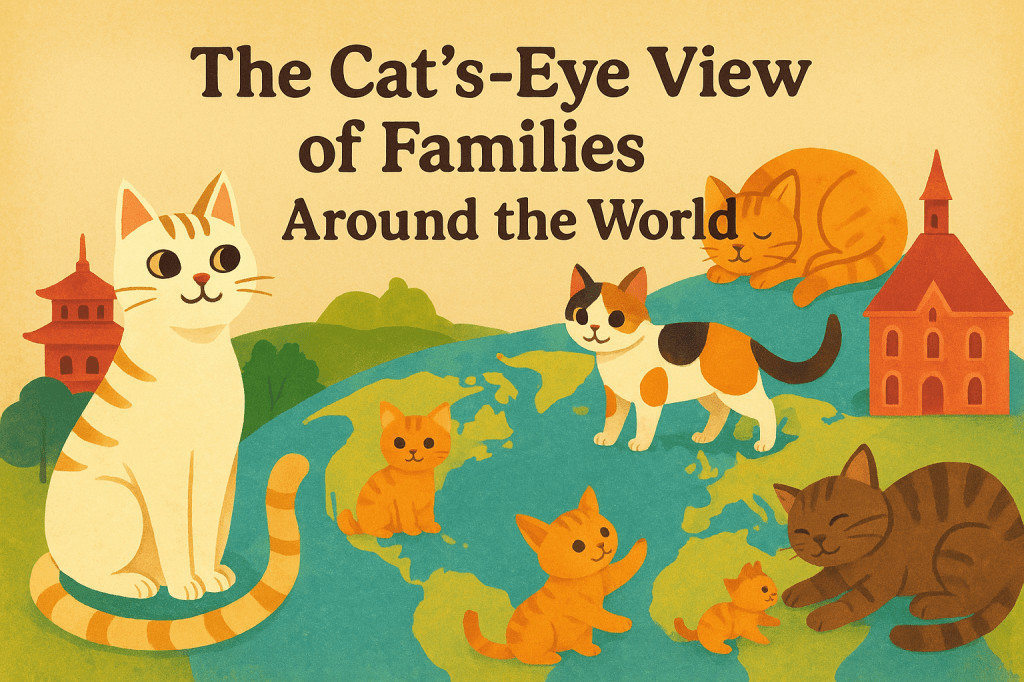
Family. A term first used in the English language around the early 15th century, hailing from the Latin word familia. It referred to a household’s servants or entire household’s servants and relatives. Then was molded into the concept of a more restrictive sense of kin in the 17th – 19th centuries.
“The family is one of nature’s masterpieces.” — George Santayana
This word shapes so much of who we are as people. It reflects our values, the way we communicate, and for some the way we see ourselves are often deeply rooted in the culture, history, religion and economic circumstances that frame our families. From meals shared to the expectations we inherit, family culture quietly but powerfully influences our identity.
“The strength of a nation derives from the integrity of the home.”
— Confucius
In this post, I want to take a short journey across continents and dinner tables. To explore how family dynamics differ in Eastern, Western and European cultures. Along the way, I’m hoping to share rituals, hierarchies, and everyday habits that make each family style unique. And if I’m lucky… maybe give us a chance to reflect on what others say about us.
Not to give away too much personal details to the internet world, but I grew up in a little southern town that has two stop lights, five fast-food places, and one local grocery store
“Home is where the cat is… and maybe the family, too.”
I often noticed the contrast between the traditions I knew from home and those I saw around me. That curiosity inspired me to dive deeper into these differences. By doing so, I hope to better understand both common threads and fascinating contrasts that shape families worldwide.
“In every conceivable manner, the family is link to our past, bridge to our future.” — Alex Haley
Clowders Around the World
So before we leap paws-first into comparisons, I think it’s best to take a pause. To clarify what I mean when I say Eastern, Western, and European families. Yes, they are still families, but these are broad categories. It’s like saying every Ragdoll, calico, and Burmilla are simply just “cats.” Which it technically true but not complete.
The truth is simple, every region holds endless diversity, shaped by their own histories, religions, and cultural quirks. Still, using these groupings can help us understand patterns, and contrasts in how families function all around the globe.
Here’s a break down
Eastern Families: Think of this as the Main heading for Asia. It’s broken into subheadings East Asia: China, Japan, Korea, South Asia: India, Pakistan, Bangladesh, and the Middle East.
Each of these places have unique traditions and emphasize interdependence, have a collective identity, and have multi-generational households.
Across Asia, family and community take center stage. East Asia cherishes harmony and respect for elders; South Asia emphasizes reputation and shared responsibilities; the Middle East thrives on extended families, traditions, and hospitality.
Think: Family bonds as strong as a kitten clinging to its mother.
Daily Life Snapshot:Daily tea ceremonies in Japan, family meals in India where food is shared from communal dishes, or evening prayers in the Middle Eastern households
Western Families: Largely known as the U.S., Canada, and Australia. Most of these families lean toward individuality, independence, and nuclear households. Basically, think of a kitten that’s starting to become more curious and not as reliant on its mother.
You know, Similar to the kittens that seem to have no fear. Always getting into things or doing before thinking.
Daily Life Snapshot: Quick weekday dinners, often on-the-go, Sunday barbecues, or sports practice becoming part of family rhythm.
European Families: Let’s categorize them by Northern, Southern and Continental.
Northern Europe, Nordic countries, are characterized as more egalitarian, with emphasis on independence.
Whereas the Southern part, Italy, Spain, and Greece, are more characterized as familistic or simply family-centered.
Continental European countries like Germany and France represent a blend, They combine strong welfare systems with slight family-centered traditions.
Picture a basket of kittens, some darting off, others snuggling close, but still a family.
Daily Life Snapshot:Italy’s evening passeggiata (family stroll), long multi-course Sunday lunches in Spain, or fika (coffee breaks) in Sweden.
I love to picture each “Cat Family” gathering in their favorite sunny spot. Some happily sitting together while others playfully run around, all taking part in their special little routines.
The Scratching Order
Eastern Families: In many of these countries, family hierarchy is clear and deeply respected. Your elders hold authority, and the younger generation are expected to show the proper obedience and deference.
Respect isn’t optional; it’s woven into every fiber of their being. We see this by their daily lives and language patterns. It’s common to call a neighbor “auntie” or “uncle” even if you have no blood ties. This show respect and belonging to that person.
Every family has their own hierarchy, whether declared or quietly known. Like a cat colony, some claim the sunny windowsill, others perch on a shelf. Kittens are quick learners about where they fall in that hierarchy.
Families across the world have their own versions of “the leader/ person in charge.” But this all varies depending on where you curl up.
Habits tied to respect & Order: Greeting elders first thing in the morning or waiting for them to start eating before anyone else.
Western Families: Across the U.S., Canada and Australia, hierarchies tend to be flatter, less rigid. Respect is still present, but expressed differently. Parents are still in charge, but the children are encouraged to voice opinions, question ideas, and explore their independence.
Using an adult’s first name is normal, even to strangers. Most discussions are more egalitarian and less follow the leader, more “every cat hunts its own bird.”
Habits tied to respect & Order: Kids calling parents by their first name in some places, or everyone pitching in on chores equally.
European Families: Europe offers a nice mix of both Western and Eastern structure. In the Southern part of Europe (Italy, Spain, Greece), the families lean towards tradition.
You know grandparents are central figures, and loyalty to family is cardinal.
Northern Europe, (Scandinavia, Germany, the Netherlands), a more egalitarian dynamic is embraced .
Children are included in the decision-making and encouraged independence early on.
Visualize this, you have two cat families. One is lounging in a pile, the other scattered across the yard but circles back to the shared food bowl.
Habits tied to respect & Order: Grandparents leading holiday traditions in Southern Europe, while in Northern it’s common for kids to negotiate their roll in family decisions.
The Paws that Roam
Cats are probably one of the most well known creatures for independence. They’ll wander off to explore rooftops, alleyways, and buildings. Only to return when the grumbling of their bellies gets too loud.
Not all families expect their kittens to leave the fold so quickly. Around the world it’s not that different if I think about it.
The different cultural norms shape whether we’re encouraged to stretch our paws early or curl up close to home.
Eastern Families: If there is one thing I can confidently say, it’s that Loyalty runs deep within Eastern families. It’s commonplace for younger adults to live with their parents until marriage.
Caring for aging parents is not only expected but honored. The family home becomes more than just a place, it’s a lifelong anchor. For some that can be a comfort and a curse.
Picture this, a whole clowder of cats. Simply a fancy-pants word for a cat group, sharing the same sunny spot, tails tangled together but content.
Habits that show how independence practiced:Daily shared breakfast or dinners anchoring everyone, even when grown kids still live at home
Western Families: On the flip side, in western families, it’s expected to move out around the age of 18. Most of these families will say it’s a rite of passage, and step toward full independence.
Many parents often encourage it and often expect it as a weird way to “prove” their parenting was a success. Though I personally think this is a flawed and somewhat cruel expectation.
It’s less of a clowder and more solo cat; a proud adventurous, determined to make their own territory.
Habits that show how independence practiced:Packing up for college with a “going away party” or weekly phone calls once kids leave.
European Families: European families seem to have a pattern of landing in the middle of Eastern and Western cultures. In many of these countries, it’s commonplace, and thankfully not stigmatized for young adults to live with their parents.
Some are even encouraged, especially if it involves studying or saving into their mid-twenties or longer. Yet, they are able to balance independence with interdependence when it’s time. There is a gradual move out, instead of abruptly like the Western counterparts.
These families are often considered as the cat who lounges in the family home during the day. But prowls new paths at night, both connected and independent.
Habits that show how independence practiced: Students living at home but returning for regular family lunches. Or balancing independence with traditions like seasonal festivals.
“Like cats returning to the same sunny spot, families find comfort in the habits that repeat”
A Personal Peek : Growing up in my small– two stoplights, Southern Town. The idea of leaving home at 18 was both thrilling and slightly terrifying.Most of my graduating class ventured off to a bigger city, while a few stayed local.
I fall into that staying local and I have loved every minute of it. Though I have thought I should have taken the chance at spreading my wings a bit more.
Though thinking back, multi-generational households weren’t unusual or frowned upon. Grandparents, aunts, and cousins often lived under one roof, to help with child care, health problems, and sharing meals.
Watching this, I realized, “leaving the nest” doesn’t have a timeline, or at least a “typical” one. It’s a dance between independence and family loyalty, influenced by culture and personality.
Whisker Whispers
Families almost seem to have their own ways to communicate, beyond words. We express love, disagreements, or frustration in a variety of ways. Just how the colors of a litter of kittens can vary. Some households encourage open chatter, others favor a quiet deference.
Understanding the patterns we use can help us see not just how families operate. But why certain behaviors feel natural or odd when we experience them.
Eastern Families: East, South, and Middle Eastern households, communication tends to be indirect. Most families favor preserving harmony and “saving face” to avoid airing disagreements openly.
The younger members of the family are encouraged to show respect. They do this by tempering their own words, even if they disagree with something. It seems like they follow the “There’s love in restraint” statement. Think of a shy kitten in a room full of curious people, wanting to pet them.
Everyday rituals how families “talk”:Checking in through small acts, such as leaving cut fruits instead of using direct words.
Western Families: U.S., Canada, and Australia, lean towards directness. Open discussions are heavily encouraged, especially if you disagree with opinions. It’s almost as if the mindset is, set to defend. I don’t think conflict is necessarily bad, it gives us the opportunity to grow and learn, and assert our individuality.
However, sometimes respect tends to fly out the window if you aren’t careful from my experience. Though, these types of family’s household are a lively room full of chatty cats. All meowing and yowling while circling to the same feeding area.
Everyday rituals how families “talk”: Family meetings, or openly debating plans and ideas.
European Families: These families seems to offer a spectrum of communication styles. They range from the highly expressive, Southern parts, such as Italy and Spain. Here emotions and passion are woven into daily interactions.
The Northern households, like Germany and Scandinavia, often favor more reserved interactions, being calm with measured less outward displays. With groups of cats, some hiss and fluffed up in a dramatic debate. Others quietly grooming, but still communicating in their own way.
Everyday rituals how families “talk”: Long family dinners that stretches on for hours in Southern parts or more structured and calm check-in on the Northern parts.
The importance of understanding these different communication styles shows how deeply culture can shape not just what families speak about, but also how they express respect, disagreement and care.
“Every family sees itself in a different mirror — sometimes polished, sometimes cracked — but always reflecting love in its own way.”
Paws & Claws
Families aren’t our first classrooms, they often set the stage for how a person dreams, works, and defines success. Depending on the culture, the path to adulthood can feel like tense. Like a tightly coiled yarn ball sprawling sunlit windowsill waiting to explore.
Eastern Families: East, South, and Middle Eastern cultures, you see a strong emphasis on academic achievement and family reputation. Kids grow up hearing not so subtle messages like; “Make the family proud.”
Success isn’t just a personal achievement, it reflects the household and family as a whole. Imagine kittens meticulously grooming to perfection, aware that every movement will be noticed by the elders watching from the windowsill.
Habits tied to ambition and Values: Parents helps with homework or extra tutoring
Western Families: In contrast, families in the U.S., Canada, and Australia seemingly encourage young adults to follow personal passions, exploring careers and interests that bring self-fulfillment. There is more of a “Follow your dreams” sentiment.
Independence and self-actualization are prized, even if the path is widening. Visualize a curious kitten, who boldly leaps onto a new counter-top. Sometimes clumsy landing, sometimes a perfect landing, but always learning and improving in its own way.
Habits tied to ambition and values:Encouraging part-time jobs or after-school activities to foster independence
European Families: Looking across Europe, attitudes are once again somewhere in the middle. Education is generally valued and encouraged, but the intensity of pressure varies by region. Some places focus on achievement, others prioritize balance.
Allowing their young adults space to explore without fear of disappointment or becoming exiled from the family. It’s best described as a clowder. Where cats are meticulously chasing after every mouse, while others sunbathe, content to observe before pouncing.
Habits tied to ambition and values:Supporting travel or gap years or prioritizing balanced schedules with downtime.
Across cultures, the ways families shape ambition reveal the delicate dance between expectation, personal growth, and a belonging.
“Some families raise us on ‘make the family proud,’ while others whisper ‘follow your dreams.’ Most of us grow up trying to balance both — like a cat torn between chasing the red dot and curling up in the safety of the sunbeam.”
Home in the Sunbeam
At the end of the day, I can’t help but notice how families are really just like cats. Some of us curl up in the sunny spot on the windowsill. Some wander off to explore rooftops and alleyways. Others, circle back again to share a warm bowl or a familiar ritual. Each of us has our own quirks, favorite nooks, little unspoken rules, and yet somehow, the clowder holds together.
For me, it’s the tiny, repeated habits that stick. The pancakes on Saturday morning, the quiet tea breaks in the afternoon. The late night chats that turn into laughter over nothing.
Those are the moments that whisper: You belong here.Not the grand gestures, but the every day rhythms that make a house a home.
I’m curious… What about you?
🐾 Do you circle the same dinner table every night, like a little ritual that never gets old? 🐾 Keep quirky traditions alive (Friday pizza, Saturday chores, or some secret family weirdness)? 🐾 Or maybe you’ve invented your own little rituals that make your family feel like yours alone?
✨ I’d love to hear—what everyday ritual feels like home for you? Maybe it’s small, maybe it’s silly, but I bet it’s important.
-Quill
Loading…
LikeLoading…
Discover more from Quill & Claws
Subscribe to get the latest posts sent to your email.