

“It’s a terrifying thing to wonder if you’re the villain in your own story.”
Quill
Have you ever realized there’s an odd silence that falls right after something goes south? There’s one question that’s been clinging to the back of my mind like a leech.
“Am I the problem?”
No curiosity.
No reflection.
Just Accusatory.
It’s not even in a dramatic, smashing windows kinda way. It’s like I’m sitting alone after another miscommunication, or whatever emotional spiral is currently happening and the thought just slips in.
“Well, the common denominator here… is me?
The question doesn’t just sting– it lingers.
It echoes.
Embedding into your skin.
The worst part?
I’m self-aware.
So aware that I can’t tell if I’m consciously averting my eyes to it.
It’s just always being “reasonable,” remaining “calm, and self-aware” gets exhausting when it’s a constant full production show.
Where I’m the director, producer, and cast & crew.
Some days, I wonder if it’s genuine growth, or if I’m just punishing myself in a different language.
“If I’m trying this hard–why am I still the person things fall apart with?”
That’s when my overthinking brain kickstarts. It’s undercover as self-improvement.
It’s heavy, exhausting, confusing.
I wonder if I’m possibly not as innocent in my own story as I want to be.
No malice.
Not Villain arc.
Just… unintentionally harmful in ways not fully understood yet.
What do I do when your growth feels accusatory?
Maybe that’s where I should start–
Not with blame, but with that uncomfortable possibility that self-awareness alone won’t cure everything like believed.
One Coin, Two sides
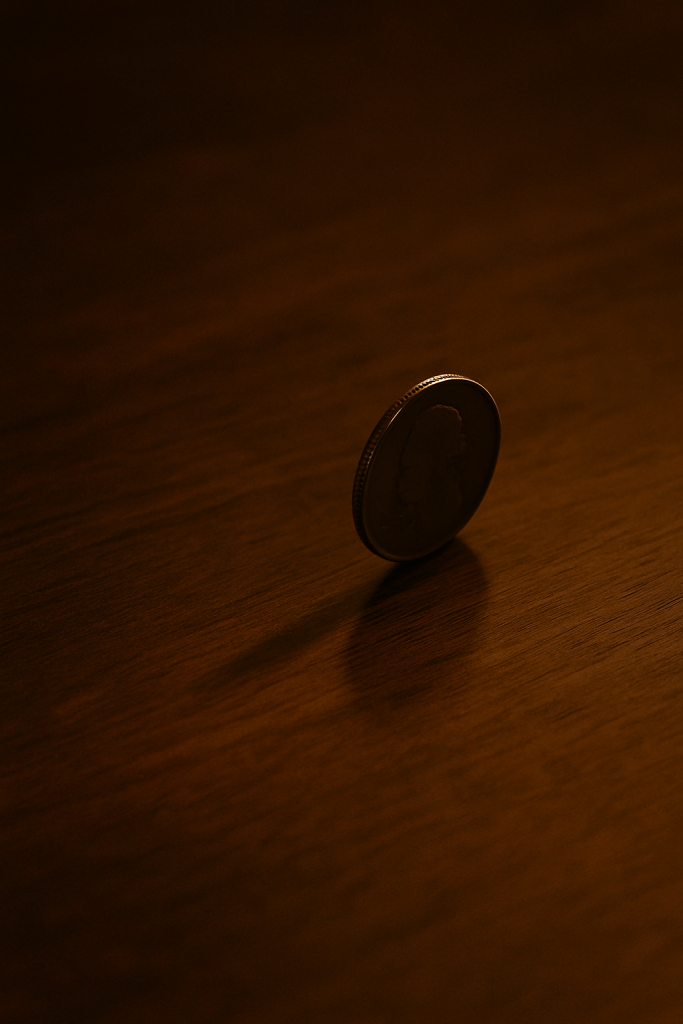
“Maybe I’m not the problem—but standing too close to one.”
You know, I get these headspaces that is somewhere between overthinking and oncoming headaches. It’s a space I sit with myself–and cat–to try and do the right thing:
Internal reflection.
Evaluate.
Understand.
And somehow, it turns into a “Hank Voight” interrogation.
It starts small and unassuming– a gentle check in:
“Alight, what’s going on?”
And before I know it, I’m locked in the “cage” staring at Hank with a crowbar in his hands.
Every mistake feels intentional.
Every reaction is disproportionate.
Every stumble is bigger.
A constant loop of:
Maybe the problem is actually me…
But there’s an ironic statement:
Self-awareness is full of blind spots.
If you stare at yourself too closely–so relentlessly intense–you will lose all sense of proportion.
Like when you wake up from a surgery, still groggy from anesthesia–the room is spinning and walls moving.
No shapes.
No definites.
No softness.
Just disorientation in a spotlight.
It’s odd.
We know having accountability is healthy.
But does that mean ignoring boundaries?
Isn’t that just self-blame wrapped in a self-help disguise.
I find myself doing this–a lot:
Saying it’s “growth” when reality it’s guilt.
Saying it’s “maturity” when it’s really just fear.
Saying it’s “reflection” when it’s really self-loathing.
I find myself swear I’m trying to improve myself with the same hands that sabotaged my–
Hands that shape the old paths, and versions of me still trying to make everyone believe i’m not being difficult or dramatic–not over the top.
So pulling apart every reaction until there’s nothing left but a thin transparent outline of a person who genuinely doesn’t know there’s a lesson here…
Or just pretending.
And there’s where that line blurs.
Where the mirrors turn into a maze.
Where the question “Am I the problem?” starts transforming from curiosity to a definite conclusion.
But maybe
I don’t have to be the villain of my story.
I’m just the one examining myself under a microscope a lot harsher than anyone else.
Mirrors don’t show the truth–not always.
Maybe it’s just a bit to close.
Reflections and Punishment
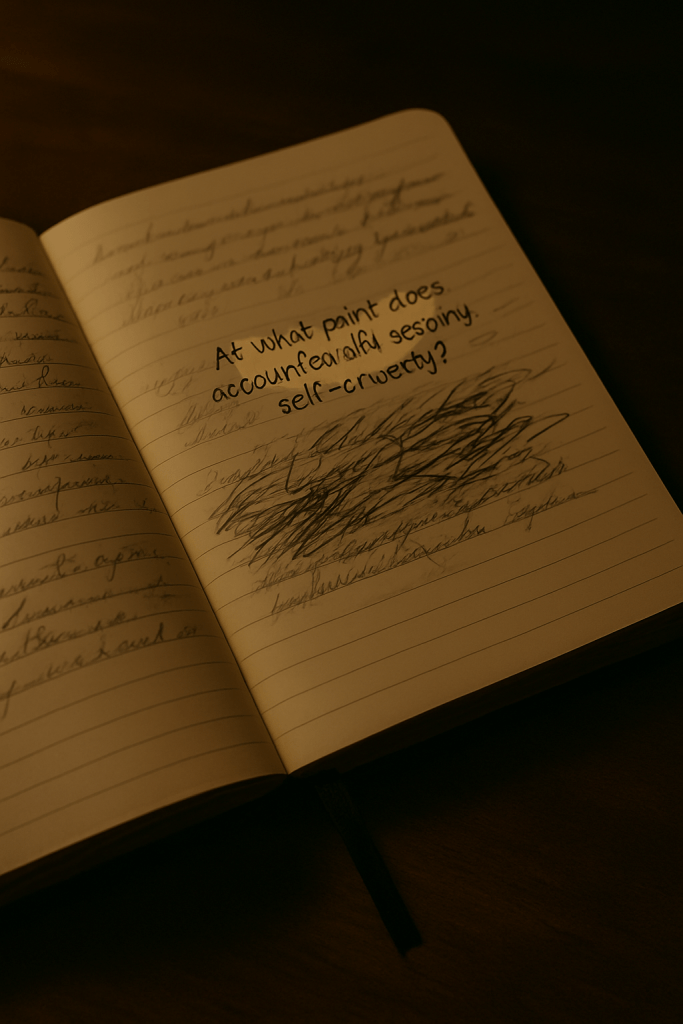
“At what point does accountability turn into self-cruelty?”
There is this hairline, barely visible line between reflecting on our actions and turning yourself into the main villain in the movie that is our life.
I’ve danced that line a multitude of times.
Listen, here’s the things people really hate talking about:
Everyone wants to be self-aware–until it’s a new tool used to torture yourself with.
It’s a small start.
A wired interaction.
That tone shift of someone talking.
An “off” moment, then suddenly your brain is in a pillory.
Was that too much?
Did I read the room wrong?
Did my words hurt them?
Did I screw up again?
And then after a while, you’re covered in rotten fruit and mud that suspiciously feels like a self-help mask.
Almost like being the one who always has to level up first.
Apologize first.
Understand first.
Take responsibility first–even when the situation has nothing to do with you
That constant emotional performance is like a steady emotional wall of calm and rationalness.
That is a heavy burden.
That heavy? It’s quiet–not dramatic or chaotic, just draining.
Think of it like carrying a backpack full of stones… uphill– gaslighting yourself by calling it “character development.”
Honesty there’s a specific kind of guilt that tends to show up for people like me, a sorta empathetic, hyper-aware, “I didn’t mean to upset you” kind.
It lingers even when I don’t do anything wrong–its truly an annoying situation.
Even when the logic supports you, it wasn’t the problem.
Unfortunately logic isn’t always the loudest voice in the room.
Your inner critic fights hard for that spot.
And she’s unforgiving.
Sometimes I have random conversations with myself asking “Is this really accountability… or preemptively punishment to myself so no one has to do it?”
You know that if I beat myself up, then nobody else will give me a surprise attack that I might’ve screwed up.
It’s heartbreaking.
It’s annoying.
And worst of all, it turns growth into self-sabotage.
Reflection should help me understand myself–not squish me into shoes three sizes too small.
Maybe the hardest thing to admit:
I’m not scared of being wrong–that’s typical for me.
I’m terrified of the possibility that my flaws I’ve attempted to fix are still waiting to burst out and reveal itself.
And if that’s true…
What does that make me?
The Truth in the Middle
“Maybe I’m not the problem. Maybe I’m just part of a story full of flawed humans trying to love each other right.”
There’s a strange moment that happens when my self-blame carousel finally slows down.
No stopping, just a breathable pause–long enough to see things without the usual veil of accusation.
And in this breathable moment, a tremor of unsettledness and relievedness show up:
Maybe I’m not the villain.
Maybe I’m not a hero either.
Maybe I’m just… me–human.
The truth is, every time I try and dissect myself like an emotional science project, I just happen to forget a crucial detail:
I’m not the only person who makes mistakes.
I’m not the only person who miscommunicates.
I’m not the only person who shuts down, lashes out, misreads or fails to show up.
Sometimes I keep getting the role of main responsibility–as if I’m in control of the entire emotional universe and have to be “perfect.”
Honestly, It’s ridiculously exhausting having to be the voice of reason and balance.
Between you and me? It’s unrealistic.
I make mistakes–plenty of them.
Not in a malicious way of course. I wasn’t trying to hurt anyone.
Most of them were created from fear and confusion, or that uncomfortable tendency humans have to act before thinking.
Somewhere along the way, I’ve started believing that taking accountability mean carrying all of it– as if that was the only way to grow was to choke down all the faults, even the one belonging to others.
That’s NOT growth.
That’s erasure.
This middle ground I’ve been introduced too–yes it’s shaky, uncomfortable, unfamiliar–but real:
A place I can say,
“Yes, I added to the mess,”
And also,
“No, I wasn’t alone in this.”
It’s where I can still want to be better without having to tear myself apart because I’m not perfect.
Where I’m allowed to show my flaws openly but still be deserving of kindness– especially from myself.

Patch Notes for My Heart
“Healing doesn’t always look like transformation— sometimes it looks like small updates no one else notices yet.”
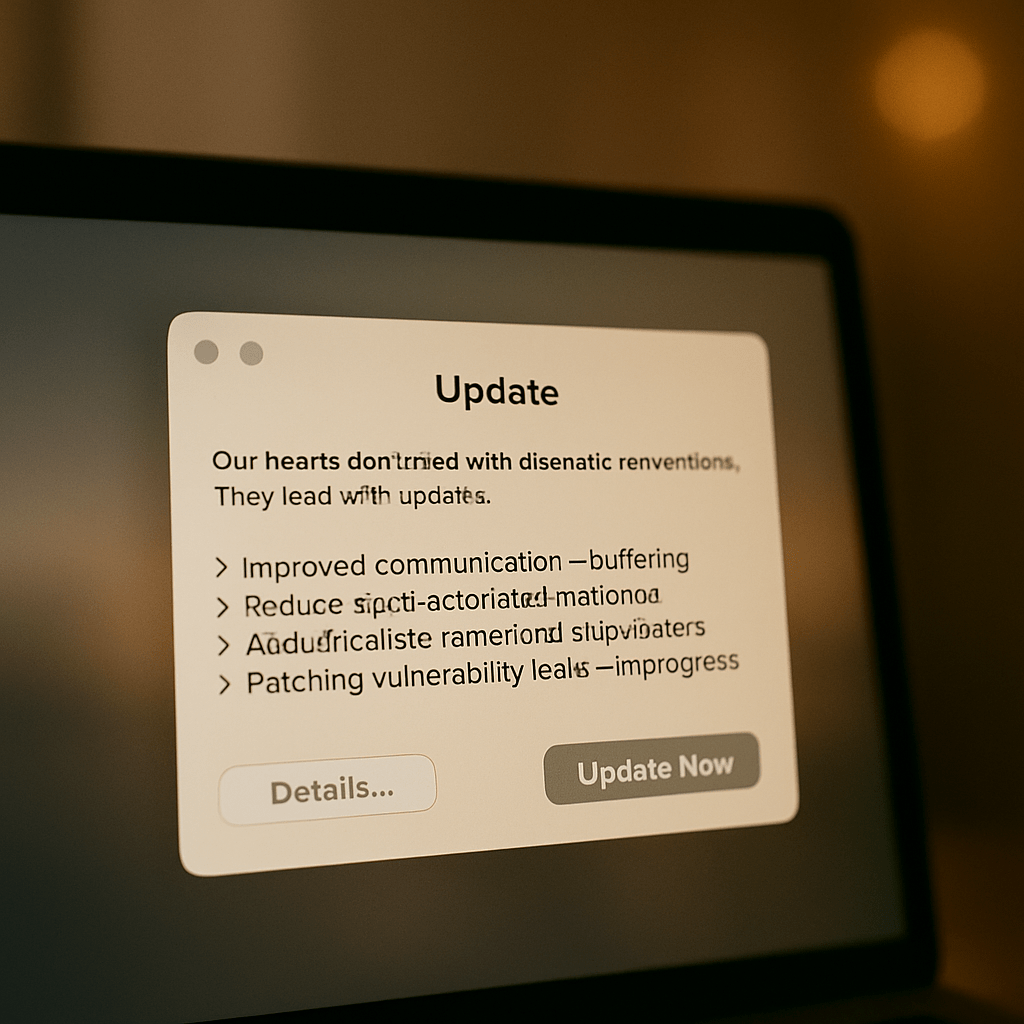
The funny thing about realizing self-growth?
You keep waiting for this big cinematic breakthrough– that “main character lightbulb moment” where the inspirational music starts playing and everything is clicking into place for them.
Instead, what I got felt more like:
“Bug Fixes: Minor emotional stability improvement. Still prone to random crashes”
For most of my life well into adulthood, self-improvement was a dramatic overhaul.
New mindsets. New Behaviors. New me.
Except… it never played out like that.
My heart doesn’t need a full reboot–just some patch notes.
Small updates with little adjustments.
Quiet acknowledgements that things that can be softened doesn’t have to get destroyed.
Truth is, I’m still slowly–reluctantly learning:
I don’t need fixing– I need maintaining.
That could look like catching myself in the start of a self-blame spiral and slowly redirect.
That could look like pausing before making an assumption that everything is my fault.
That could look like realizing my patterns are character flaws, but survival skill I no longer need but haven’t retired yet.
And frankly, just admitting to myself:
“I’m doing the best I can with this current version today.”
Our hearts don’t heal with dramatic reinventions.
They heal with updates:
> Improved communication– buffering
> Reduced self-sabotage frequency
> Added feature: emotional boundaries
> Patching vulnerability leaks– in progress.
The more i embrace these ideas, the more comfort is realized:
Perfection doesn’t equal functional.
Healed doesn’t mean loved
A villain is the other side to a hero.
I’ll just keep updating.
Keep learning.
Keep choosing softness even with an attack from fear.
Maybe that’s all growth should be–
A continuation patching of the parts of me that are trying thier best in a world that keeps changing.
Honestly?
That’s enough.
Final Boss: Grace:
“You don’t have to ne flawless to be worthy— you just have to be willing to grow.”
I was always under the assumption that finding out whether I was”the problem” would give me peace of mind.
Clarity even.
But what I got was quieter and kinder than expected:
I’m not the problem.
I’m not blameless either.
I’m just learning as I go.
Trying doesn’t need to have a cinematic flair.
Change doesn’t need perfection.
And self-awareness doesn’t equal self-punishment.
Maybe I can take that as the real victory–not having to prove my innocence and make room for grace.
Grace to grow.
Grace to be wrong.
Grace to build myself up without shredding myself completely first.
I’m still trying to figure it out just like everyone else.
Still processing everything.
Still updating my inner software.
But for now, I’m not doing it from my throne of blame.
I’m doing it from a place of love and care.
And honestly?
It’s such an incredible feeling–it changes everything.
When was the last time you stopped trying to fix yourself long enough to notice you were already doing better?